
Most people spend their preparation time on expression and lighting and approximately none on what is behind them. That is a costly oversight, because at the size a profile photo is actually seen, the background decides whether you read as a clear subject or as visual noise.
Since our founding dataset, Background & Context has been one of the two criteria that most often drags a photo's total down. Across 347 dating-goal submissions carrying per-criterion scores, it averaged 52.4 / 100 — below the other four criteria — and was the single weakest criterion in 26.8% of photos. See how we score it.
Across 347 dating-goal submissions, Background & Context had a mean score of 52.4 / 100 and was the weakest of the five criteria in 26.8% of photos — the most common single weak point in our dating sample. A further 11.2% of photos had it as their strongest criterion, so this is a differentiator in both directions. Read the full methodology.
Why Backgrounds Affect a Photo More Than You Think
The mechanism is processing load. When the brain reads a face, it is simultaneously parsing the entire scene around it. A busy background forces the viewer to separate subject from context — extra work that competes with the impression your face is trying to make.
There is neuromarketing research pointing the same way. Unravel Research, a Dutch EEG and eye-tracking lab, ran a dating-app photo study using brain-activity measures and reported that photos requiring more cognitive effort to process were associated with lower attraction ratings. Treat that as directional evidence rather than a precise law: it is a small, commercial study, but it is consistent with a much broader principle in visual perception — clutter costs attention.
The practical implication is the same either way. A clean, well-separated background lets the viewer spend all of their attention on your expression. A cluttered one makes them spend it working out what is behind you.
The Principle: Optimise for Separation, Not Scenery
Here is where most background advice goes wrong. It ranks locations — "outdoor bokeh beats studio grey beats white wall" — as though there were a universal hierarchy. There is not, and we will not invent one. What actually determines whether a background works is a single measurable relationship: how cleanly do you separate from it?
A beautiful street scene with a shirt the same tone as the sky fails. A plain grey wall with a clearly contrasting top succeeds. Separation is about the relationship between three things — your hair, your skin, your clothing — and the values directly behind you. Judge a background by that relationship, not by how impressive the location is.

Six Background Types, Judged by How They Separate
The following is editorial judgement based on the separation principle and thousands of scored submissions — not a measured ranking of background types. Our sample is not large enough to publish a per-type score, and we would rather say so than fabricate one. Use it as a starting framework, then verify on your own image.
1. Natural outdoor bokeh
A natural setting with genuine depth blur gives you both separation and context. The blur handles the separation; the setting supplies a lifestyle signal and, on dating apps, a conversational hook. The failure mode is a background whose colours sit too close to your clothing — green foliage against an olive jacket defeats the point.
2. Neutral studio grey or a plain matte wall
The most reliable choice for professional contexts, and the easiest to reproduce at home. A solid neutral removes all competing detail and gives you total control over contrast. Its weakness is on casual platforms: with no context at all, a studio-grey backdrop can read as stiff. If you shoot against a plain wall, make sure it is genuinely plain — a single frame, cable, or shelf reintroduces the clutter you removed.
3. A softly blurred interior
A café, library, or clean modern workspace adds a mild lifestyle signal without a full location shoot, provided the depth of field is strong enough to push the detail back. This works best when the interior is tonally calmer than you are. If a pattern, a bright window, or another person competes for attention, it is no longer a supporting background.
4. Plain white wall
Not automatically bad, but harder than it looks. Bright white risks clipping and losing texture under strong light, and it offers poor separation for people with pale skin or light clothing. It also carries an ID-photo association in some contexts. A cream or off-white wall avoids most of these problems while keeping the clean look.
5. Busy or patterned backgrounds
Every additional element behind you is another thing the viewer's eye has to sort out. Patterns, crowds, signage, and strong geometrical lines are the most common culprits. This is the category most likely to be scored weakest under Background & Context, because the criterion asks whether a stranger's eye lands on you first — and clutter guarantees it will not.
6. Flat artificial or virtual backdrops
Virtual backgrounds and heavy cut-outs are their own category. The problem is not aesthetics but authenticity: visible edge artefacts around hair and shoulders are a classic tell, and a tell is a trust cost. A real blurred background almost always beats a synthesised one for a profile photo.
Platform-Specific Background Strategy
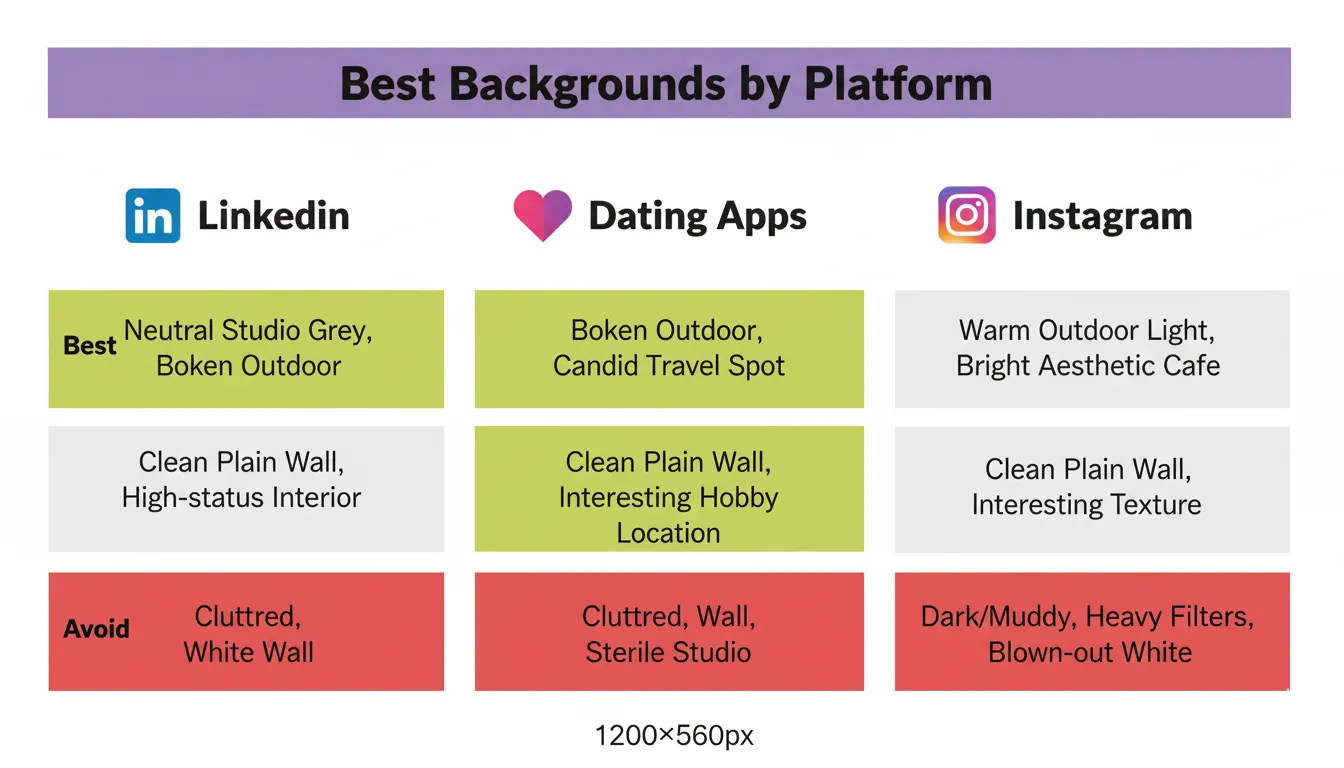
The right background depends on what the platform's audience expects a photo taken for that purpose to look like:
LinkedIn: formality signals competence, so a neutral studio grey or a clean blurred interior reads best. The goal is a background the viewer has no opinion about at all, so their full attention stays on your face. Context-heavy location shots, while stylish, can read as casual.
Dating apps: context signals lifestyle, so an outdoor or recognisable setting earns its place — it says you have a life worth asking about and gives a natural opener. Studio-grey backdrops, excellent for LinkedIn, tend to look over-prepared here.
Instagram: coherence with your feed matters most. The profile photo has to work as a tiny circle and as part of an overall palette. Choose a background that both separates from the shot and sits inside the tone of your grid.
The Distance Rule: The Highest-Leverage Background Technique
This is the single most useful and least-known change you can make. The further you stand from your background, the softer it becomes — with or without Portrait mode. At half a metre from a wall, the wall stays sharp and detailed. At two metres, the same wall visibly blurs.
The reason is basic optics: the further an object sits from the plane you focused on, the more out of focus it becomes. So the practical sequence is: push as far from the background as your space allows, then turn on Portrait mode. Doing the distance work first produces markedly cleaner separation than relying on the portrait effect alone.
How BestPick Scores Your Background
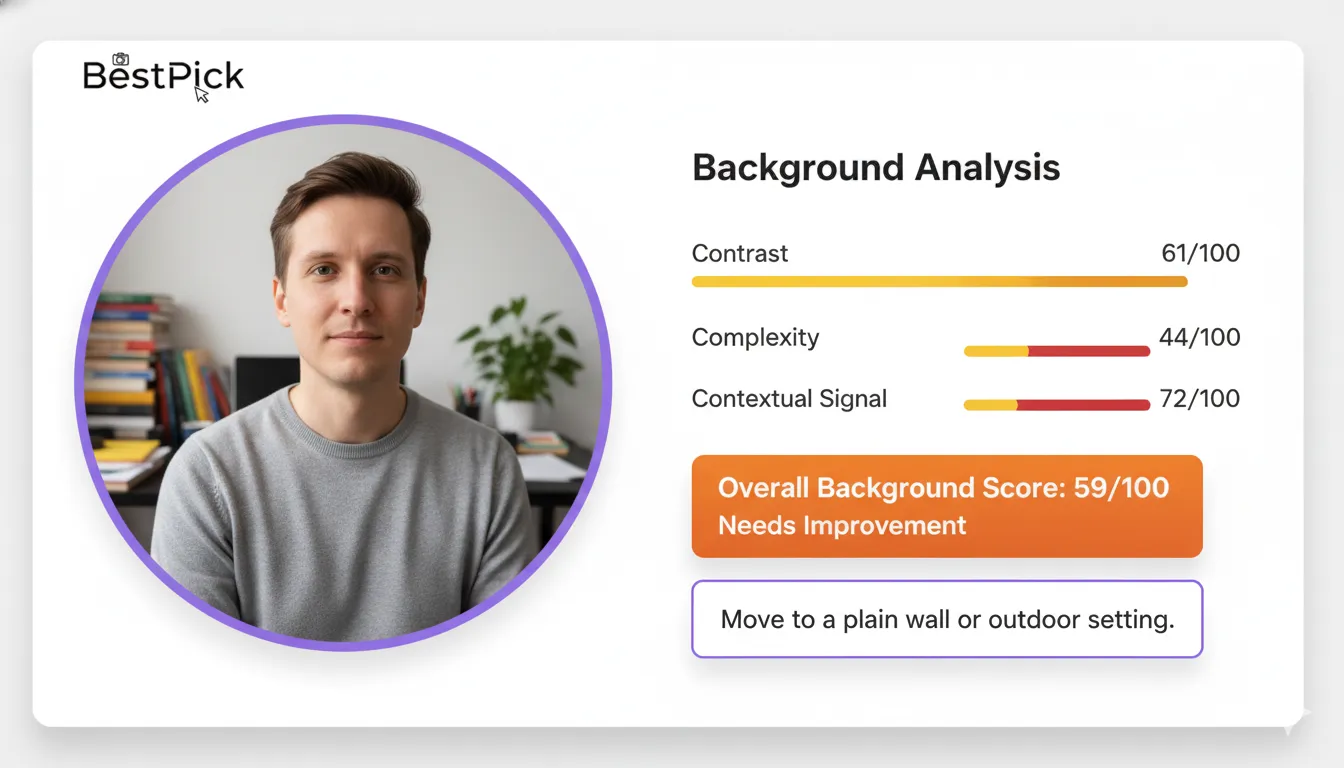
When you upload to BestPick, the background is not scored by a separate module — there isn't one. It is one of five criteria in a single rubric, and the model answers a single question: does the setting support the subject, or compete with them? That judgement is scored 0–100, with written reasoning, against the same calibration bands as every other criterion. You can read exactly how that works on our methodology page.
Frequently Asked Questions
Find Out How Your Background Is Scoring
Upload your photos to BestPick and get a Background & Context score — plus written feedback on exactly what to change — in seconds. Free, no account needed.
Analyze My Photo Background Free →