Most "best colours to wear" articles give you a list of hues and no way to know whether it applies to your photo. That is backwards. The colour that matters most is not on any list — it is the relationship between your outfit and the background behind you.
Here is what we can say from our own data, what we genuinely cannot, and the one principle that should decide your outfit whenever the list-based advice runs out.
BestPick does not score clothing colour, and we hold no data linking a colour to matches, views, or messages — nobody does without platform access. What we can measure is the two criteria colour touches indirectly. Across 347 dating-goal submissions, Background & Context had a mean of 52.4 / 100 and was the weakest of the five criteria in 26.8% of photos — the single most common failure. Styling & Grooming averaged 58.0 and was weakest in 12.4%. Not the deciding factor, but a real one. See the methodology.
Why "Best Colour" Lists Are Mostly Guesswork
Colour affects a portrait through two separate mechanisms, and they are constantly confused with each other:
- The psychological effect — what a hue is believed to signal (red = bold, navy = trustworthy). This is what listicles are selling.
- The optical effect — how the colour behaves in the actual photograph: contrast against the background, colour cast on skin, and whether the fabric clips under bright light. This is what you can verify by looking at your own image.
The second mechanism is measurable, and it is the one that decides whether a photo reads clearly at thumbnail size. That is why we lead with contrast rather than hue.
The One Principle: Buy Separation, Not a Colour
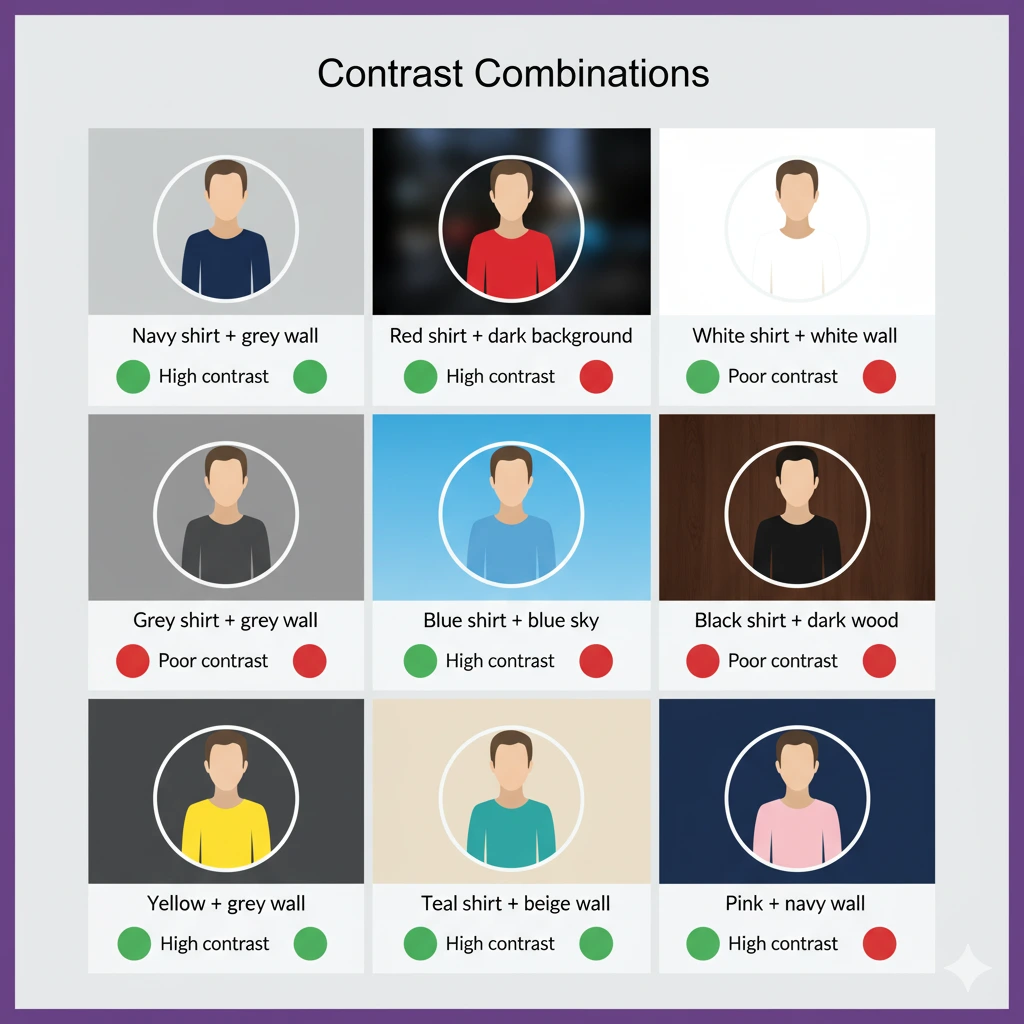
At the size a profile photo is actually viewed — a small circle in a feed — the eye cannot resolve fabric texture or subtle colour psychology. It resolves edges. A subject whose shoulders separate cleanly from the background reads as a clear, confident focal point. A subject who blends into the wall reads as visual mush, no matter how good the expression is.
So the practical rule is simple: choose a top whose tonal value is clearly different from your background, and only then worry about which hue.
| Your background | Choose a top that is… | Avoid |
|---|---|---|
| Light / white wall | Dark and solid — navy, charcoal, burgundy, forest green | White, cream, pale pastels |
| Green / outdoor foliage | Warm and contrasting — rust, burgundy, cobalt, warm white | Olive, sage, khaki |
| Dark interior / brick | Lighter tones — cream, warm white, light grey, mustard | Black, dark brown, deep navy |
| Busy or patterned scene | Flat, saturated solids that don't repeat the noise | Stripes, logos, heavy prints |
Platform Guidance (From Research, Not From Our Data)
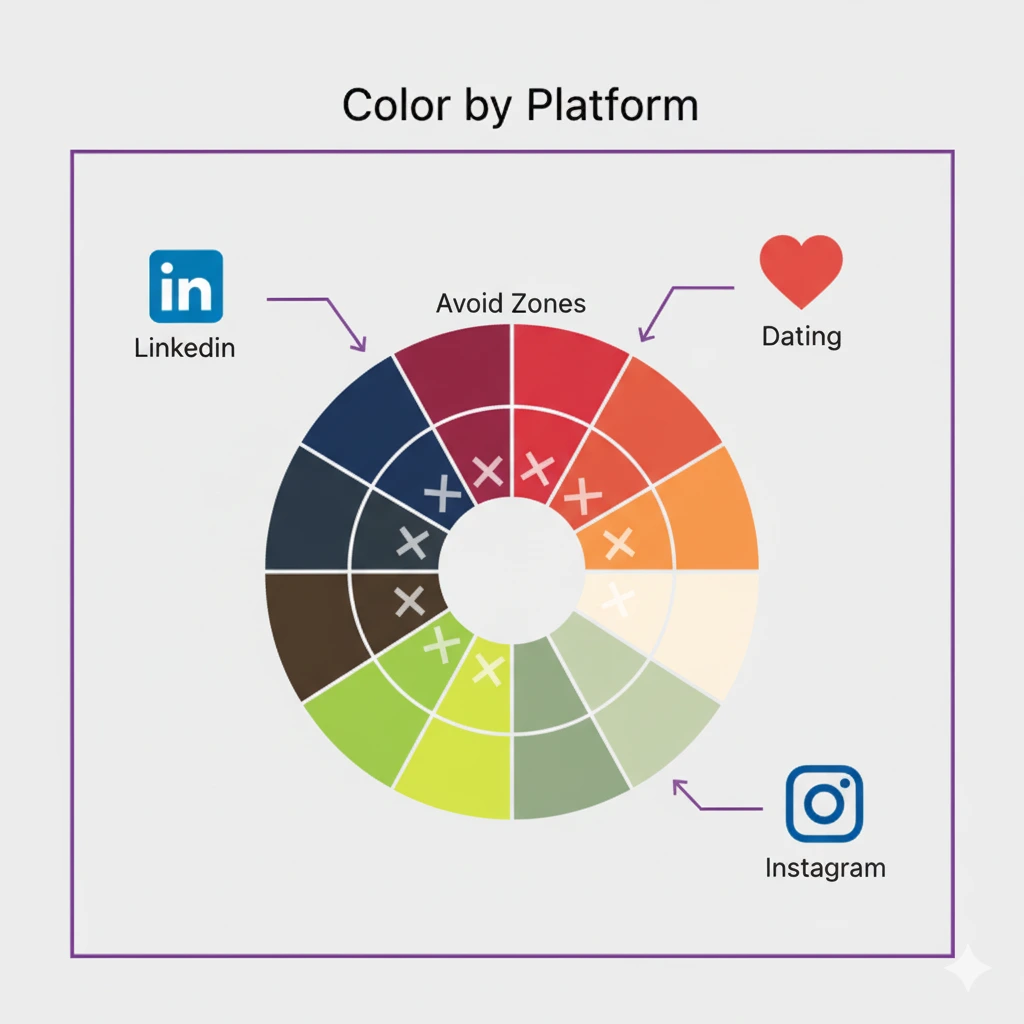
Once separation is handled, the remaining choice is tone. Here the honest label matters: the following is drawn from published colour-perception research and platform norms, not from BestPick submissions. We score whether an outfit looks deliberate; we do not score its hue.
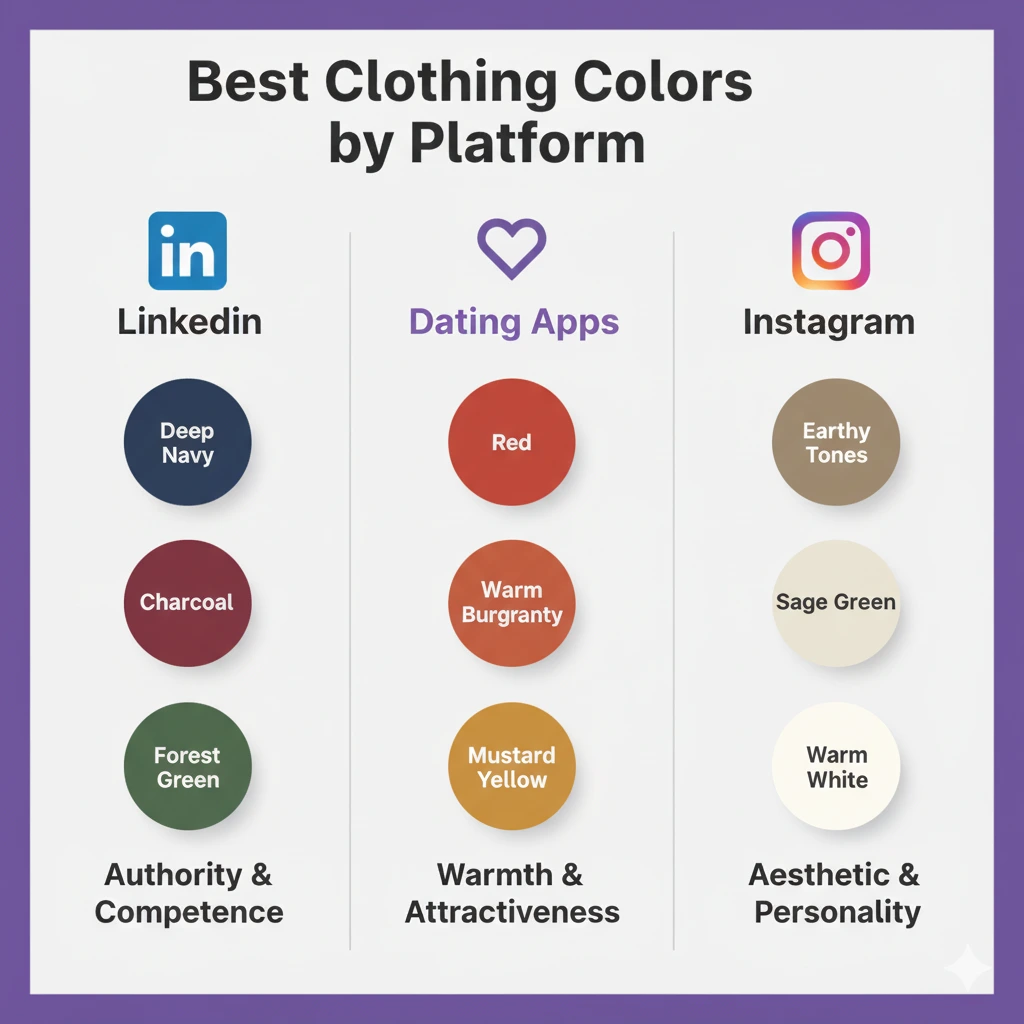
LinkedIn: authority tones
Mid-to-dark neutrals and saturated darks dominate professional photography for a reason: navy, charcoal, burgundy, and forest green photograph cleanly, avoid colour cast on skin, and separate well from the light-grey or white backgrounds common in corporate settings. Pure black can work but tends to crush detail and read harsh under high exposure. Skip neon, heavy patterns, and pure white against a white wall.
Dating apps: warmth tones
Dating profiles reward approachability over authority, so slightly warmer and less formal tones tend to feel more human: rust, terracotta, mustard, warm burgundy, or a soft cobalt. There is also real published research on red — Elliot and Niesta's 2008 study in the Journal of Personality and Social Psychology found red clothing increased men's ratings of women's attractiveness in a controlled setting. Treat that as a genuine but modest effect, not a cheat code, and never at the cost of separation from your background.
Instagram: consistency tones
Instagram asks a different question: does this photo cohere with the rest of your grid? The profile photo has to work as a small circle and as part of a palette. Choose something that both separates from the specific shot and sits inside your feed's overall tone — sage, earthy neutrals, warm white, and muted cobalt are common, but your grid decides the answer.
The Three Colour Mistakes That Actually Cost You
These are the colour problems that show up as measurable quality losses, in rough order of impact:
- Blending into the background. The most common failure (see Background & Context above). A light top against a white wall or a dark top against a dark interior removes the subject edge the viewer needs.
- Colour cast on skin. A saturated top under mixed or coloured lighting can bounce its hue onto your face — a bright yellow shirt near warm indoor light is the classic offender. Check the whites of your eyes and teeth for a tint.
- Clipping and distraction. Pure white blows out against bright light; patterns, logos, and high-contrast stripes pull the eye away from your face at thumbnail size.
How to Test Your Outfit in 30 Seconds
Before you commit, shrink the photo to a coin-sized thumbnail on your screen. This is the size that matters. If your shoulders and hairline no longer separate from the background, change the top — not the pose. Then check the two colour-specific failure modes: any tint cast onto your skin, and any element (pattern, logo, blown-out white) pulling attention off your face.
And if you are still choosing between two outfits, that is exactly the decision our comparison tool was built for: score both photos and let the model weigh separation, styling, and the rest of the rubric for you.

About the Author
Saad Sellami is a digital psychology researcher and the lead algorithm architect at BestPick, working on computational photography and the behavioural science of first impressions.
Already Have Photos? Let BestPick Score Them.
Upload your candidates — including photos with different outfits — and BestPick will compare them across the full rubric: expression, background separation, styling, eye contact, and lighting.
Analyze My Photos Free →