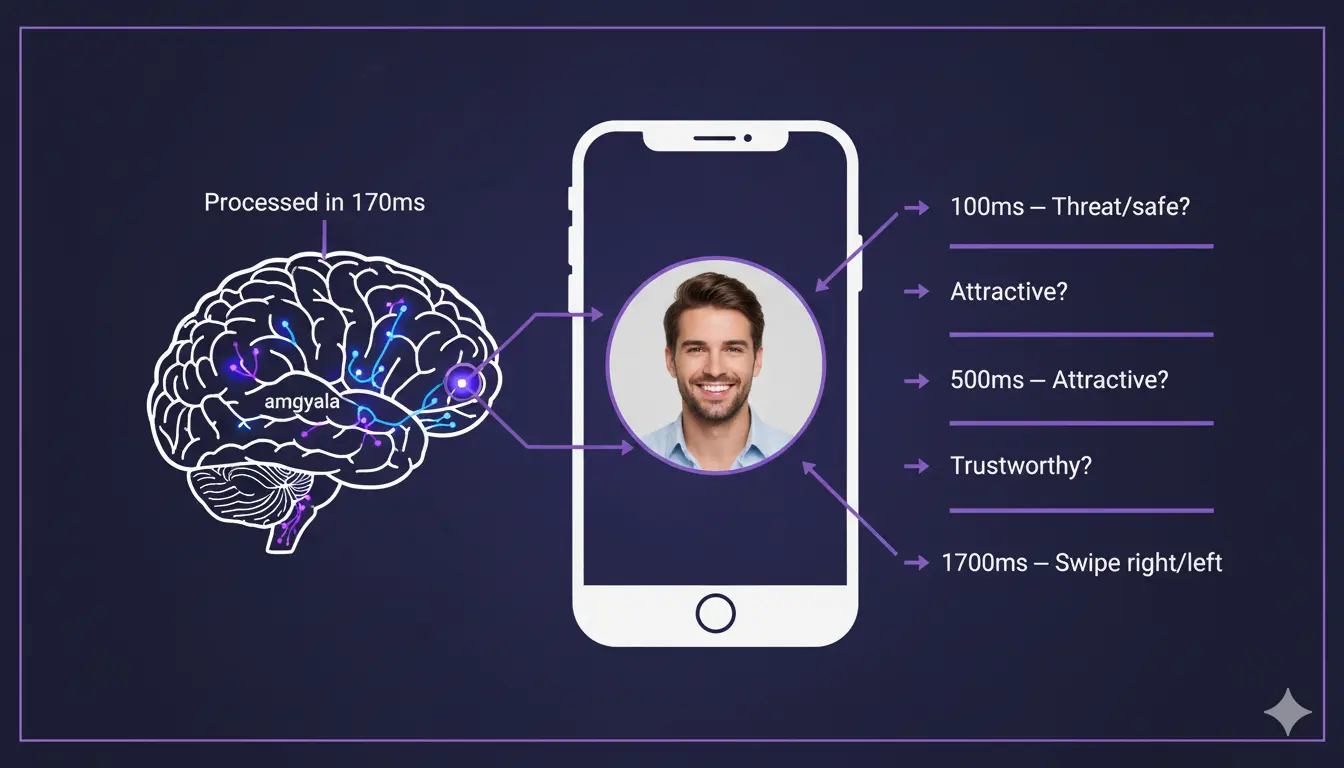
A Princeton University study found that people form judgments about attractiveness, likability, trustworthiness, and competence from a face in as little as 100 milliseconds — less than a tenth of a second. That is not the time it takes to consciously evaluate a photo. That is the time it takes for the brain's visual cortex and amygdala to process the raw image and deliver a verdict before conscious thought begins.
Your profile photo is not assessed the way you assess it. When you look at your own photo, you see context — you know that your smile was genuine, you remember the good day you were having, you know the story behind the photo. A stranger sees only what is visible. And what is visible triggers a cascade of instantaneous psychological judgments that are largely outside conscious control — on both sides.
Understanding what those judgments are, and what visual signals trigger them, is the foundation of choosing an effective profile photo. BestPick's AI analysis engine is built around exactly this research — which is why our photo scores correlate with real-world engagement outcomes rather than subjective aesthetic preferences.
Across all BestPick photo submissions, the single most predictive variable for a high score is expression authenticity — specifically, whether the smile engages the orbicularis oculi muscles around the eyes (Duchenne smile) or not. This one signal predicts platform performance more reliably than lighting quality, background, or composition alone.
The 6 Judgments Strangers Make From Your Photo
Research in social cognition, compiled from studies at Princeton, Harvard, and multiple European universities, identifies a consistent hierarchy of judgments that people make from a face — including a face in a profile photo:
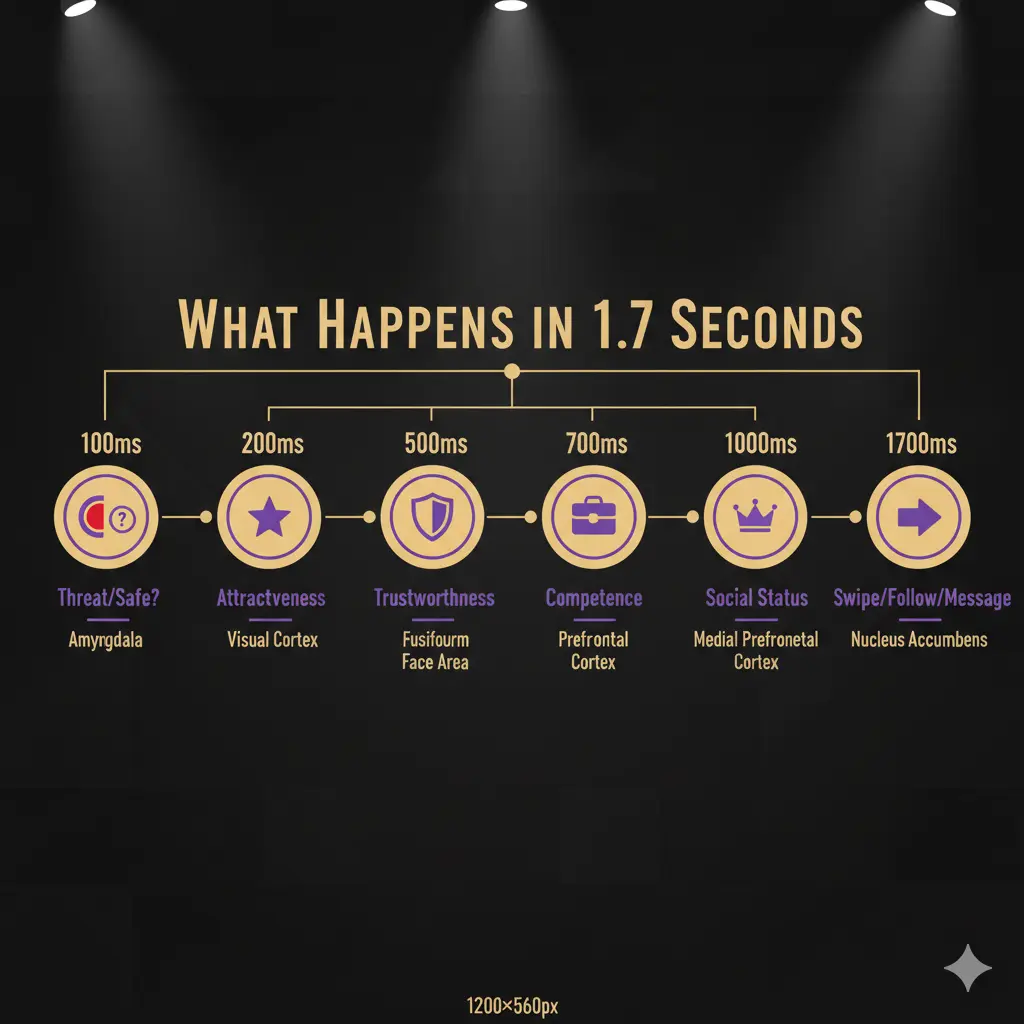
1. Threat / Safety (100ms)
The brain's first question when encountering a new face is binary: threat or safe? This judgment is processed by the amygdala before conscious perception begins. Factors that reduce perceived threat: direct but relaxed eye contact, open posture (not crossed arms, not turned away), and a neutral-to-positive expression. Tense jaw, furrowed brow, and averted gaze all elevate perceived threat slightly — not dramatically, but enough to suppress the "approach" response that leads to a follow, a swipe right, or a message.
2. Attractiveness (200ms)
Physical attractiveness judgments follow immediately. Crucially, research shows these judgments are heavily influenced by photo quality — lighting, contrast, sharpness, and framing — independent of the person's actual physical characteristics. A well-lit photo of an average-looking person consistently scores higher on attractiveness ratings than a poorly lit photo of an objectively more attractive person. This is the fundamental insight behind BestPick: photo quality and selection matter independently of how you look.
3. Trustworthiness (500ms)
Trustworthiness is the most important judgment in professional contexts (LinkedIn, professional networking) and relationship contexts (dating apps). The primary visual signals: genuine smile, symmetric expression, forward-facing gaze, and relaxed — not tense — facial muscles. BestPick does not score trustworthiness; it is not one of the five criteria, and we have no way to measure whether a stranger trusted you. What we can measure is the expression itself: across 339 dating-goal submissions, Facial Expression & Warmth averaged 52.3 / 100 and was the lowest-scoring of the five criteria in 24.8% of photos — one of the two most common weak points — Background & Context and Facial Expression & Warmth are effectively tied.
4. Competence (700ms)
Competence is judged partly from facial features but significantly from contextual signals: background (an office, a city environment, or a professional setting implies competence), clothing (visible professional or smart-casual attire), and posture (upright, confident framing). For LinkedIn specifically, these contextual competence signals matter as much as the expression itself.
5. Social Status (1000ms)
Social status inference comes from social proof signals: are other people visible and engaged with you (suggesting you are liked)? Is the background environment high-quality (suggesting access to resources)? Is your grooming polished? These signals combine to create a rapid social status assessment that influences whether a stranger perceives you as worth pursuing.
6. Relationship Potential (1700ms)
By 1.7 seconds — where the TruShot data cited by the NCBI puts the dating app decision threshold — the brain has assembled all previous signals into an overall "yes/no" for pursuit. This is the cumulative verdict. Every photo decision you make upstream of this moment contributes to it.
The Neuroscience of the Genuine Smile
The human brain has a dedicated system for detecting fake smiles — and it works faster than conscious awareness. The difference between a genuine and a posed smile is the Duchenne marker: genuine smiles engage the orbicularis oculi muscle around the eyes, creating crow's feet wrinkles and a slight raising of the cheeks. Posed smiles engage only the zygomaticus major (the mouth corner muscle) without the eye engagement.
Brain activity studies using EEG show measurably different neural responses to Duchenne versus non-Duchenne smiles — even when the conscious viewer cannot articulate why one photo "feels" warmer than another. Our perception of smile authenticity is pre-cognitive.
BestPick has no dedicated smile detector. It scores each photo against five fixed criteria, one of which — Facial Expression & Warmth for dating photos — asks whether the expression reads as genuine rather than posed. Across 347 dating-goal submissions it averaged 52.3 / 100, among the lowest of the five criteria.
Eye Contact and the Psychology of Gaze
Eye-tracking research on profile photo viewing confirms that the eyes are the first feature viewers fixate on — typically within the first 200 milliseconds of viewing a face. Direct eye contact with the camera creates a psychological simulation of real eye contact: a sense of connection, acknowledgment, and engagement that looking away does not produce.
Unravel Research's neuroscience study on Tinder photos found that images where the subject looked directly at the camera generated measurably higher theta wave activity — a neural marker associated with attraction — compared to photos where the gaze was averted. This held even when controlling for other photo variables.
In our own data, eye contact is rarely the problem. Across 347 dating-goal submissions, Eye Contact & Confidence averaged 58.2 / 100 and was the weakest of the five criteria in only 8.1% of photos — the least common weak point. Most people already meet the lens; what they get wrong is what is behind them and what their face is doing.
Background Psychology: What the Scene Behind You Communicates
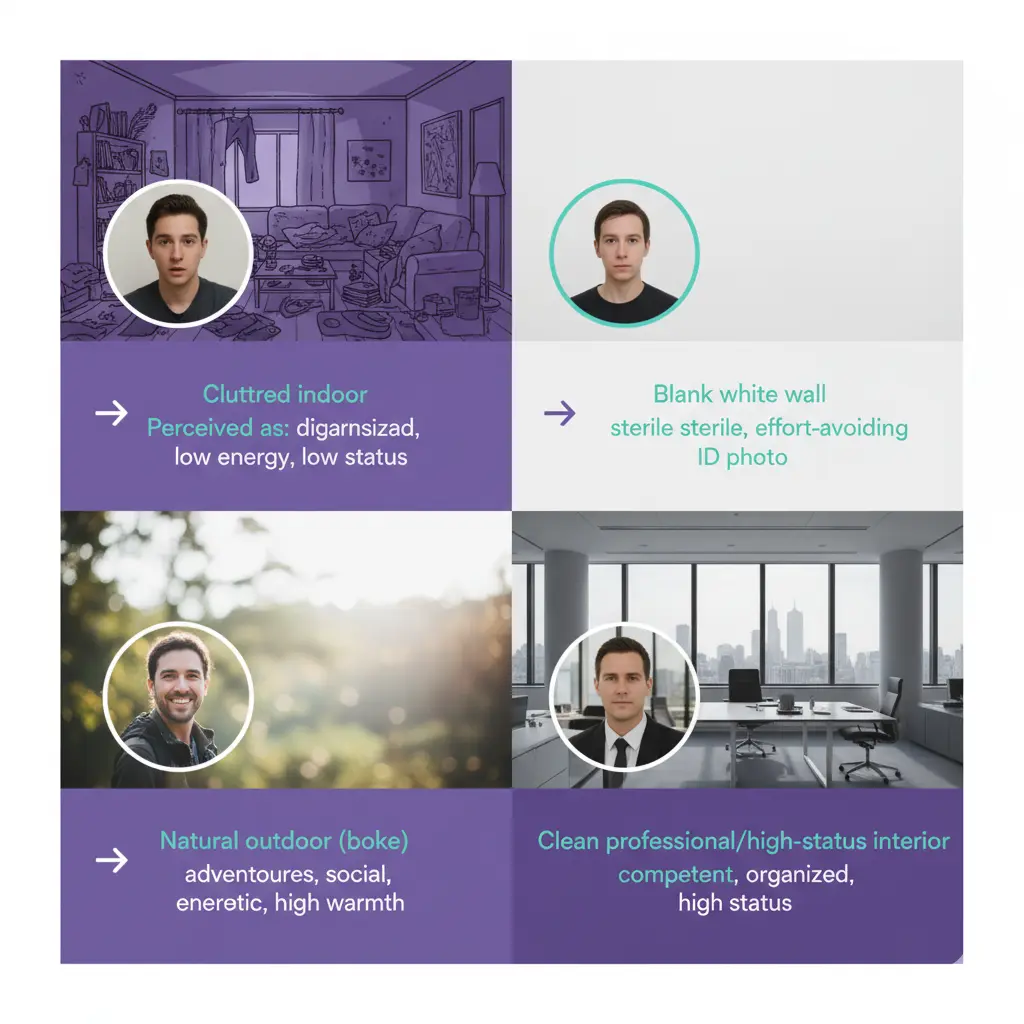
Research in social psychology confirms that context shapes personality judgments. The background of your profile photo is not neutral — it actively communicates information about your social status, lifestyle, personality, and energy level, all below conscious awareness.
A study analyzing dating app photo backgrounds found that outdoor backgrounds (parks, cities, travel destinations) were associated with higher perceived adventurousness, social engagement, and energy. Indoor backgrounds were associated with introversion and homebodiness — not necessarily negative, but a different personality signal. Cluttered backgrounds triggered negative judgments about organization and attention to detail that participants could not consciously explain.
Background is scored under a single criterion — Background & Context — which asks whether the setting supports the subject or competes with them. Across 347 dating-goal submissions it averaged 52.4 / 100 and was the weakest criterion in 26.8% of photos.
How to Use This Psychology to Choose Your Photo
The practical takeaway from this research is not that you need to manufacture a different version of yourself — it is that you need to choose the photo that best captures the psychological signals you are naturally capable of projecting.
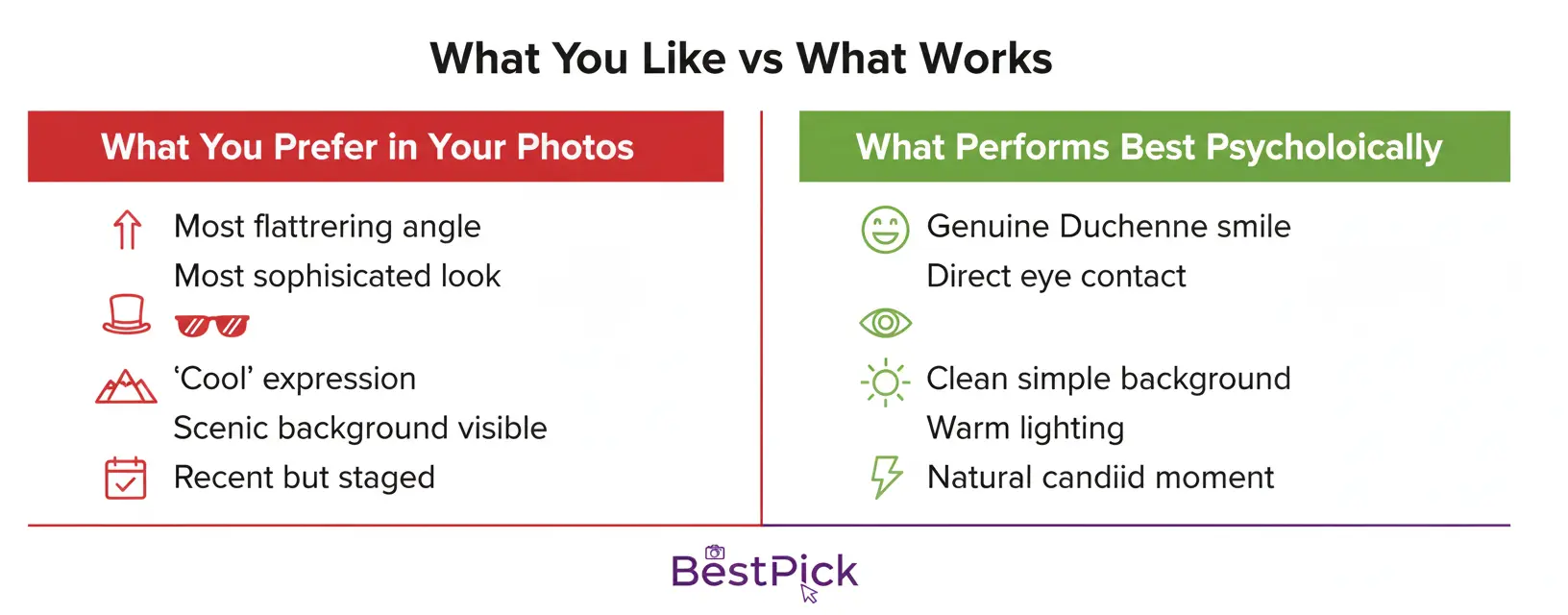
You probably already have a photo somewhere that shows a genuine Duchenne smile, direct eye contact, good light, and a clean background. The challenge is that the psychological signals that make a photo effective are often not the same signals that make you personally like a photo of yourself. You might prefer the photo where you look thinnest, or most sophisticated, or most "cool" — but none of those preferences are what drives a stranger's 1.7-second decision.
This is the exact problem BestPick is built to solve. Upload your candidate photos, select your platform, and receive an AI-driven score based on the specific psychological signals that drive engagement on that platform — not your own biased self-assessment.
Stop Choosing With Your Biased Self-Perception. Let the AI Decide.
BestPick scores your photos based on the same psychological signals that drive real-world engagement — not which one you like most of yourself.
Analyze My Photos Free →