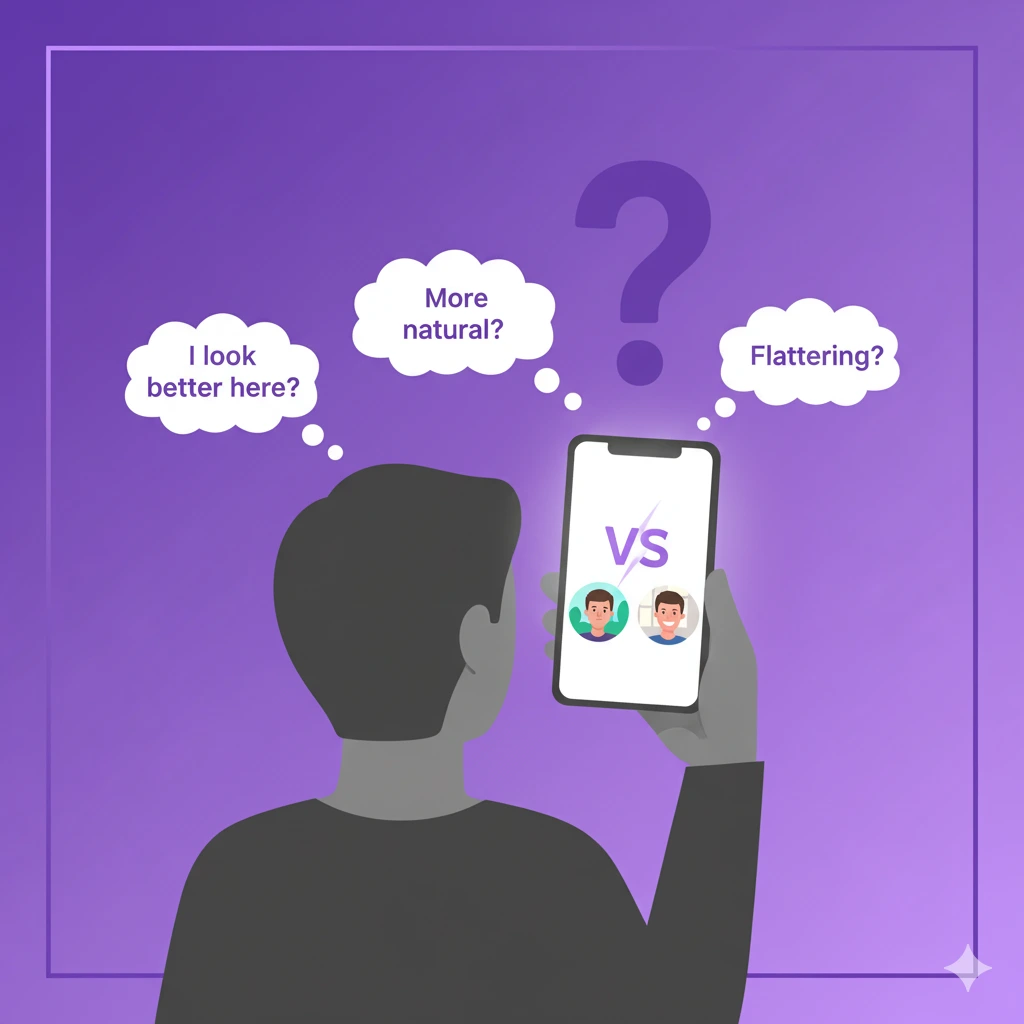
We have all been there. It's 11 PM, your thumb is hovering over your camera roll, and you are aggressively swiping back and forth between two seemingly identical photos. You have narrowed it down from fifty shots to just two. And now, you are completely stuck.
You start asking yourself questions you cannot possibly answer objectively: "Which one is more me?" "Does my jawline look weird in this one?" "Is this smile too much, or is the other one too serious?"
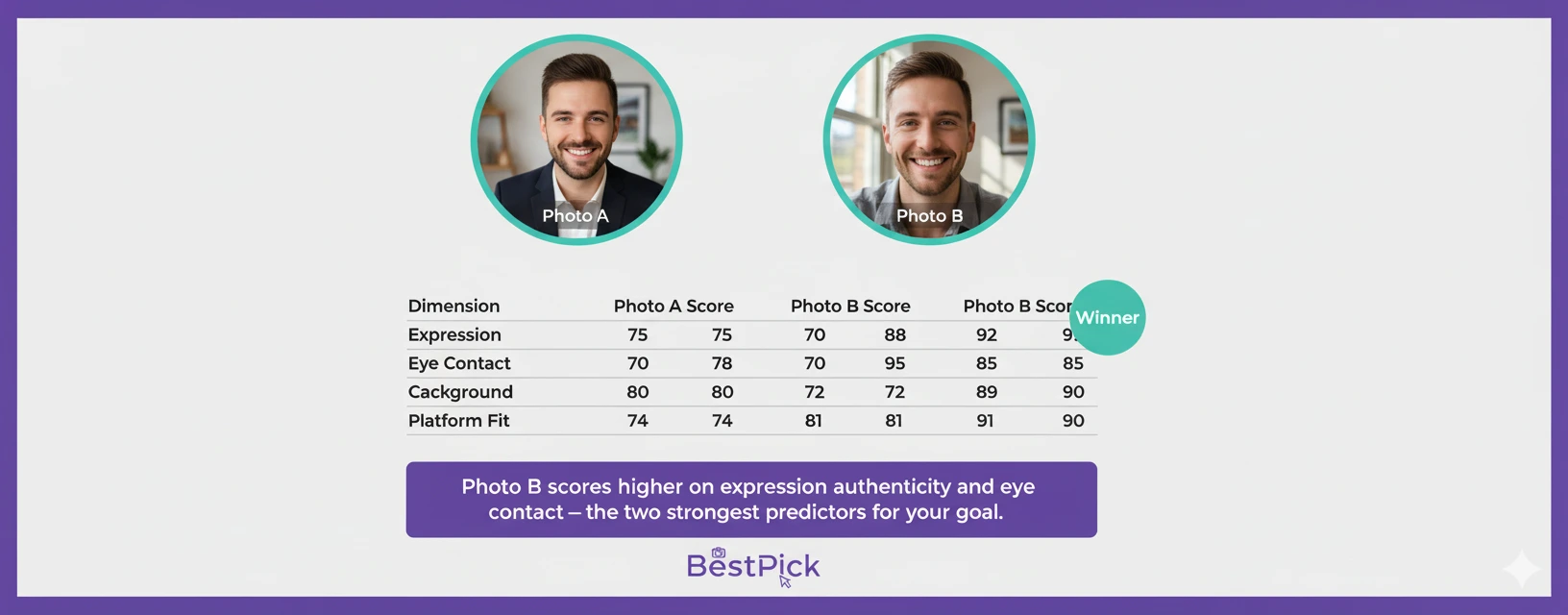
This agonizing bottleneck is incredibly universal. In fact, it is the single most common scenario our tool was built to solve: you upload two photos, the model scores both on the same five criteria, and the higher score wins. But the score is the easy part. The genuinely useful question is which criterion actually separates two photos you already like — and for that we can turn to our own data.
But simply getting the answer isn't enough. Understanding why your brain freezes when trying to judge your own face is crucial. Once you understand the psychology behind photo selection, it fundamentally changes how you approach personal branding—whether you are setting up a LinkedIn profile to land a corporate executive role, or optimizing a Hinge profile to find a partner.
Across 527 dating-goal photos in the BestPick dataset, the average score is 54.5 / 100 and 66% land below 60. The weak-point breakdown is what matters for a close call: Facial Expression & Warmth was the lowest-scoring criterion in 24.8% of photos and Background & Context in 26.8%. Lighting, by contrast, was the strongest criterion in 34% of photos.
In other words, most photos are already adequately lit. When two decent photos feel impossible to choose between, the gap is almost always in expression and background — not in technical quality. See the full methodology.
The Psychology of the Mirror: Why You Can't Objectively Judge Your Face
If you feel frustrated that you can easily pick the best photo for your friend, but go completely blind when looking at yourself, don't worry. You are fighting against decades of documented cognitive bias.
The primary culprit is a psychological phenomenon known as the Mere Exposure Effect (first identified by psychologist Robert Zajonc in 1968). The mere exposure effect dictates that humans develop a strong preference for things simply because they are familiar with them.
Think about how you have viewed your face for your entire life. You see it in the bathroom mirror every morning. You see it in the rearview mirror of your car. Because mirrors reflect light, the version of your face you are intimately familiar with is technically reversed.
When someone takes a photograph of you, it captures your face as the world sees it—un-reversed. Because human faces are inherently asymmetrical (one eye slightly higher, a jawline slightly sharper on one side), looking at an un-reversed photo of yourself causes mild cognitive dissonance. Your brain flags it as "wrong" because it doesn't match the mental map you've built from decades of looking in mirrors.
The Self-Enhancement Trap
Beyond the mirror effect, we also suffer from self-enhancement bias. When we look at photos of ourselves, we aren't looking at the whole picture. We immediately zoom in on our deepest insecurities. If you are self-conscious about your nose, you will reject a photo where your nose looks prominent, even if the photo captures a beautifully warm, radiant smile that makes you look incredibly charismatic.
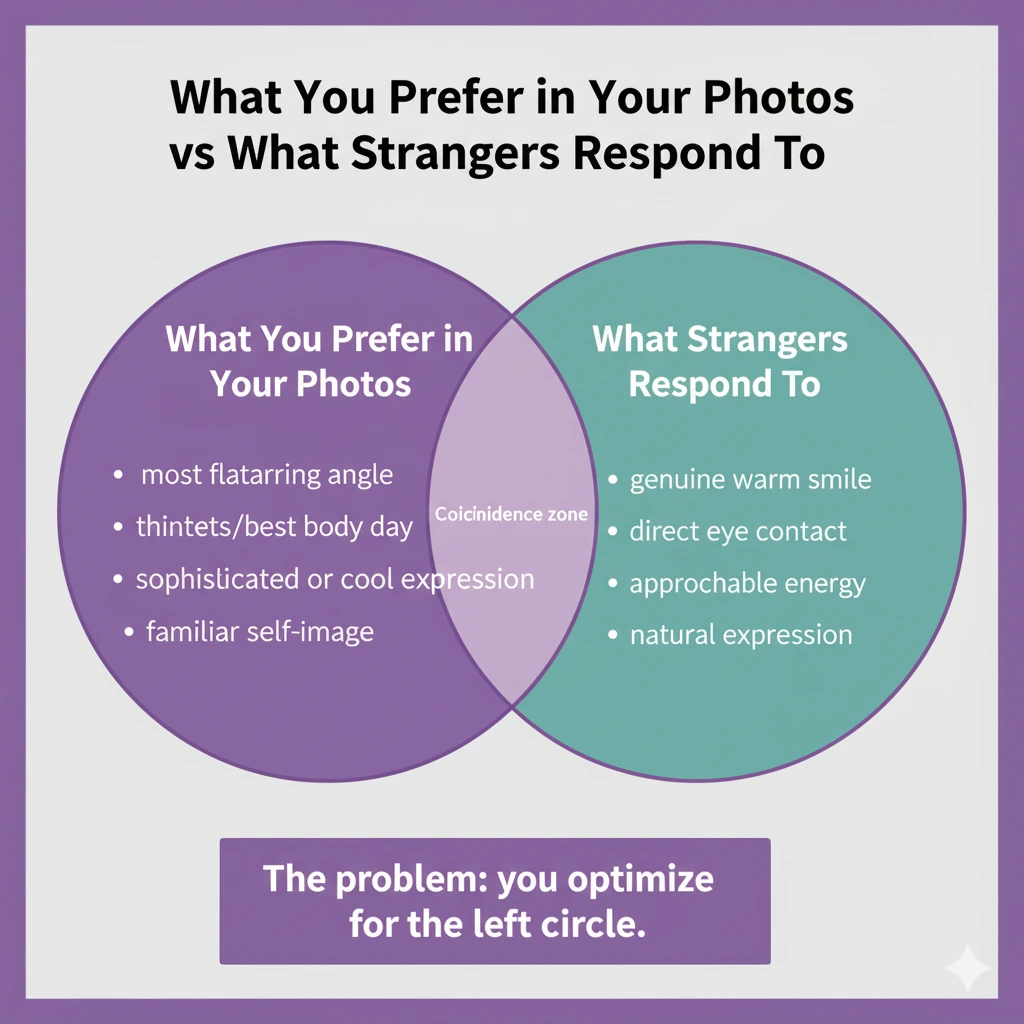
Strangers do not do this. Strangers are evaluating your photo cold. In the split second it takes someone to swipe on Tinder or click a LinkedIn profile, they are not examining your nose. They are processing high-level evolutionary signals: Is this person safe? Are they warm? Do they look confident? Are they approachable?
This is the fundamental disconnect. You are optimizing your photo to hide your insecurities; a stranger is looking at your photo to gauge your human energy. Those two goals rarely produce the same winning photograph.
The 5 Criteria We Actually Score (and What Each One Catches)
To remove emotion from the equation, you need a consistent way to evaluate imagery. When the BestPick model compares two photos, it does not care about your good side. For dating-goal photos it scores the same five criteria on every image, each out of 100:
| Criterion | Mean score | Weakest in | Strongest in |
|---|---|---|---|
| Facial Expression & Warmth | 52.3 | 24.8% | 13.8% |
| Background & Context | 52.4 | 26.8% | 11.2% |
| Styling & Grooming | 58.0 | 12.4% | 13.5% |
| Eye Contact & Confidence | 58.2 | 8.1% | 10.1% |
| Lighting & Facial Clarity | 61.6 | 10.7% | 34.0% |
Dating-goal photos, n = 527 (criteria scored n = 347), BestPick dataset, August 2025 onward. "Weakest in" / "Strongest in" = share of photos where that criterion was the lowest / highest of the five. Full methodology.
Read the table once and a useful pattern jumps out. Lighting & Facial Clarity is the most common strong point (34%) and the least common weak point (10.7%). Most photos we score are, technically, adequately lit. That means lighting rarely decides a close call. The two criteria that most often fail — Facial Expression and Background — are therefore the two that most often separate two otherwise-similar photos.
1. Facial Expression & Warmth
The single most decisive criterion, and the one people most often get wrong. We look for the Duchenne marker — the contraction of the orbicularis oculi muscle that crinkles the corners of the eyes. A posed smile engages only the mouth; a genuine one reaches the eyes. In our dating set this criterion had the second-lowest mean score (52.3) and was the weakest of the five in roughly one in four photos. If Photo A has a real, relaxed expression and Photo B has a posed smirk or a flat stare, Photo A wins.
2. Background & Context
The most common single failure in our dating data (weakest in 26.8% of photos). Your face should not have to fight for attention. A cluttered bedroom, a bathroom mirror, or a busy street behind your head raises the viewer's cognitive load and makes the photo feel effortful to read. Look for subject separation: does the background contrast with your hair and clothing, and is it simple enough that you remain the clear focal point? Between two photos with similar expressions, the cleaner background usually decides it.
3. Eye Contact & Confidence
Where are you looking? Direct eye contact builds immediate trust — when your eyes meet the lens, the viewer's brain registers that you are looking at them. This was the weakest criterion in only 8.1% of our photos, so it is rarely the deciding gap, but a photo where you are squinting into the sun or looking away will still lose to one with clear, open eyes.
4. Styling & Grooming
This covers how deliberately you are presented: clean, simple clothing that does not compete with your face, tidy hair, and no distracting logos or loud patterns. Its mean score (58.0) sits mid-pack and it was the weakest criterion in 12.4% of photos — a real but secondary differentiator when two photos are otherwise evenly matched.
5. Lighting & Facial Clarity
Photography literally means "drawing with light," but in practice this is the criterion our users already handle best. Soft, directional light — think standing at a 45-degree angle to a large window — wraps around the face and creates depth, while harsh overhead light casts shadows under the eyes and nose. Because most photos score well here, lighting is the least likely reason one of your two photos beats the other; use it as a tie-breaker, not the headline.
A note on scope: these five criteria apply to dating-goal submissions. Social/general photos are scored on a different rubric (Composition & Framing, Vibe & Mood, Visual Hook, Aesthetic Appeal, Authenticity). The methodology page documents both.
The Friend Trap: Why Asking for Opinions Backfires
When faced with the two-photo dilemma, the immediate instinct is to text the options to a group chat. "Hey guys, left or right?"
While asking friends is marginally better than trusting your own warped perception, it introduces a completely different type of bias. Your friends suffer from contextual memory bias.
Let's say you send them a photo taken on a group trip to Mexico where you all had an amazing, hilarious time. Your friends will almost certainly vote for that photo. Why? Because when they look at it, they don't just see your face—they remember the margaritas, the sunset, and how much fun you were that day. The photo makes them feel good.
But a hiring manager on LinkedIn or a potential date on an app wasn't in Mexico. They don't have that context. They are only reacting to the pixels on the screen. If the lighting in that Mexico photo is terrible and your eyes are hidden in shadow, the stranger will swipe left, regardless of how much your friends loved the picture.
To get a true read on a photo, you must simulate the cold, fast, contextless judgment of a stranger. Historically, people used crowdsourcing platforms like Photofeeler for this. While effective, it requires paying for credits and waiting for humans to log on and vote. An AI selector applies a fixed set of criteria to the same photos in seconds, which makes it a faster way to get the same kind of cold read.
Stop Guessing. Let Data Decide.
Don't text your group chat. Upload your two favorite photos directly to our engine. We will analyze the lighting, micro-expressions, and psychological triggers to tell you definitively which one will perform better.
Run the A/B Test Now →The 60-Second Manual Selection Method
If you find yourself needing to make a quick decision and absolutely cannot use an AI tool to grade the photos, you have to force your brain to stop looking at the images as "pictures of you" and start looking at them as abstract data points.
Here is a simple 4-step manual exercise that forces you to look past the face:
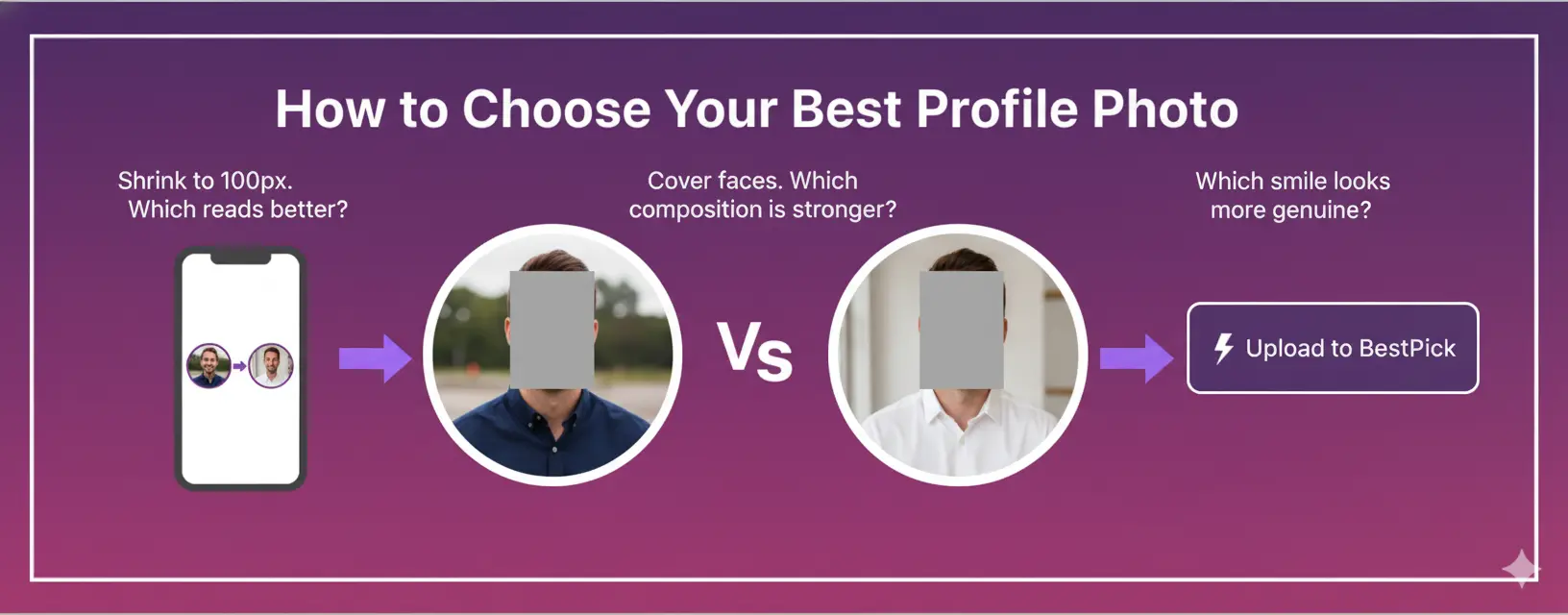
- 1. The Thumbnail Test: Shrink both photos down on your screen until they are roughly the size of a coin (about 100x100 pixels). This is exactly how they will appear in a crowded feed or comment section. At this size, fine details vanish. Which photo has higher contrast? Which face pops out from the background clearly? Delete the one that turns to visual mush when shrunken down.
- 2. The Squint Test: Open the photos full size, lean back, and squint your eyes until the image becomes blurry. Again, this removes your ability to hyper-fixate on your nose or teeth. You are now evaluating purely on lighting and composition. The photo with the brightest, most even light on the center of the face is structurally superior.
- 3. The Face Cover: Hold your thumb over your actual face in both photos. Look strictly at what is happening around you. Is there a trash can in the background of Photo A? Is the shirt collar in Photo B sitting awkwardly? You'd be surprised how often a terrible background ruins a great face.
- 4. The Eye Isolation: Finally, uncover the faces, but block out the mouths. Look only at the eyes. Are the eyes relaxed and warm, or wide, tense, and deer-in-the-headlights? The mouth lies; the eyes do not. Choose the photo where the eyes look comfortable.
If you go through these four steps and the answers conflict (e.g., Photo A has better lighting, but Photo B has warmer eyes), always default to the photo with the better, more authentic expression. Human connection trumps technical perfection every time.
Real-World Scenarios: A/B Testing in Action
To ground this theory, let's look at two incredibly common dilemmas we see in the BestPick database every week.
Scenario A: The Professional vs. The Friendly (LinkedIn)
Photo 1: The user is wearing a sharp, tailored suit. The lighting is studio-perfect. They are staring at the camera with a serious, intense, "I am a high-powered CEO" expression.
Photo 2: The user is wearing a simple button-down shirt. The photo is taken outside. The lighting is good but not perfect. They are laughing genuinely at something off-camera.
The honest answer: Photo 2 is usually the safer pick. Our professional-goal sample is too small to publish a per-scenario ranking, but the broad principle is consistent with the rubric: a warm, genuine expression reads as more approachable than a formal, stoic one. That said, the right choice depends on the role — a stiff expression is not automatically a liability, and a genuine smile is not automatically an asset in every industry.
Scenario B: The "Hot" vs. The "Approachable" (Dating Apps)
Photo 1: A mirror selfie taken at the gym or in a bathroom. The angles are manipulated to show off the jawline or physique perfectly. The expression is a pout or a smolder.
Photo 2: A slightly lower-resolution photo taken by a friend at a coffee shop. The user looks happy, relaxed, and natural, but perhaps their hair isn't absolutely perfect.
The honest answer: Photo 2 is generally the better profile choice. A relaxed, natural image gives the viewer more to respond to, while a heavily posed mirror selfie is a narrower signal. We do not have outcome data on conversations or dates — no third-party tool does — so we will not claim a measured multiplier. What we can say is that the rubric rewards expression and context over pose, which is where the relaxed photo wins.
Final Thoughts: Let Go of the Details
Choosing between two photos is exhausting because you are treating the photo as a measure of your self-worth. You are analyzing your flaws instead of assessing your overall impact.
The hard truth is that strangers do not care about the slight bump on the bridge of your nose, or the fact that your left eye is marginally smaller than your right. They are looking for a spark of life, a sense of warmth, and a feeling of safety.
Stop overthinking the pixels. Start optimizing for the human connection. And if you still find yourself paralyzed by the choice, take a step back, take a breath, and let the objective data make the call for you.

About the Author
Saad Sellami is the founder and lead engineer at BestPick, where he designed the photo-scoring rubric and the analysis pipeline behind it. He writes about computational photography and the behavioural science of digital first impressions.